FANS (Future Air Navigation Systems) is a datalink system that lets pilots and ATC (Air Traffic Control) communicate directly, using digital text transmissions that appear on the CDU (Control Display Unit). Developed by ICAO (International Civil Aviation Organization), Boeing, Airbus, Honeywell, and others, FANS was an early datalink standard developed to solve a very specific problem: how to safely manage aircraft beyond radar coverage, particularly in oceanic and remote airspace. In these “Dark zones”, tracking relied on slow, periodic voice reports, which limited how closely planes could fly together. The introduction of FANS effectively eliminated these gaps by creating a virtual radar environment across more than 34 Flight Information Regions (FIRs) worldwide. This is achieved through Automatic Dependent Surveillance Addressing (ADS-A)

As global airspace becomes more congested, combining two existing systems as FANS replaced error-prone voice communication with more structed, digital messages. FANS works by using time-based procedures to keep aircraft separated.
- CPDLC (Controller Pilot Data Link Communications)
This is the end of the radio era in the cockpit. Instead of volatile high-frequency voice radio, pilots and ATC communicate via clear, digital text messages displayed on the aircraft’s Control Display Unit (CDU). This transition is “silent and automatic,” drastically reducing the potential for human error from misunderstood verbal instructions.
- ADS-C (Automatic Dependent Surveillance – Contract)
This system turns a simple aircraft into a “virtual radar” source. Using the plane’s highly accurate onboard GPS and Inertial Reference Systems, the Flight Management System (FMS) automatically transmits its precise position, speed, and flight plan to ATC (Air traffic control) via satellite data links, usually between one to five minutes. This creates a constant, high-fidelity stream of data where none existed before.
How does FANS work in Aviation?
Unlike traditional radar, which “pings” an aircraft, FANS-equipped aircraft utilize their onboard Inertial Reference Systems (IRS) and the Global Positioning System (GPS) to calculate highly accurate position data. This information is processed by the Flight Management System (FMS) and automatically transmitted via satellite data links, such as Inmarsat to controllers at intervals of one to five minutes. By providing a constant stream of high-fidelity data where none existed before, FANS allows controllers to manage oceanic traffic with the same precision once reserved for continental airspace.
How does FANS work in Aviation?
Unlike traditional radar, which “pings” an aircraft, FANS-equipped aircraft utilize their onboard Inertial Reference Systems (IRS) and the Global Positioning System (GPS) to calculate highly accurate position data. This information is processed by the Flight Management System (FMS) and automatically transmitted via satellite data links, such as Inmarsat to controllers at intervals of one to five minutes. By providing a constant stream of high-fidelity data where none existed before, FANS allows controllers to manage oceanic traffic with the same precision once reserved for continental airspace.
Why FANS Matters to Airlines
Dynamic Rerouting and Fuel Savings:
Before FANS, flight planning often relied on weather data that was many hours old, leading to conservative, fuel-heavy routes. With FANS’ satellite data links, the flight crew receives real-time weather updates while en route. This allows them to use “User Preferred Routings” and dynamically reroute around weather, saving significant amounts of fuel and increasing the allowable weight for paying passengers and cargo.
- Eliminating the 4,000-Foot Penalty:
Traditional aviation, lacking precise surveillance, often required one of two converging aircraft to fly 4,000 feet below its optimal, fuel-efficient altitude to maintain safe separation. FANS resolves this using “intent data.” Since controllers know a plane’s projected path and speed, they can precisely stagger arrival times at crossing points, allowing both aircraft to stay at their most efficient cruising altitudes. This translates to long-term savings on engine wear and fuel expenditure.
FANS 1/A to FANS 2/B its evolution
The technology has come a long way since its debut in the Pacific in 1996.
First Generation (FANS 1 / FANS A): These early systems used the slower ACARS network for data transmission, proving the concept primarily in low-density oceanic airspace.
Second Generation (FANS 2 / FANS B): We are now seeing the shift to these advanced architectures. They utilize the faster Aeronautical Telecommunications Network (ATN) protocol to relieve the congestion of older systems. This evolution is vital for bringing FANS’ capacity-solving capabilities into high-density continental airspace, such as Europe’s “Link 2000” trials.
Fans in Europe VS USA
In Europe, FANS is now mostly a legacy/exception solution for upper‑airspace ATC, while in the US it remains the primary technology for both oceanic and a growing amount of domestic CPDLC services.
The EU
- European rules now require CPDLC to be provided specifically via ATN VDL Mode 2 for most IFR flights above FL285 in “Single European Sky” airspace. The goal is to make this the official language for controller‑pilot messaging in busy upper airspace. EASA explicitly says that using “CPDLC via FANS‑1/A cannot ensure the performance requirements” of the European data link rules; only ATN CPDLC over VDL Mode 2 is considered fully compliant.
- Many FANS‑equipped aircraft are allowed to keep flying under exemption rules (if they were certified before certain dates, Jan 1ST 2018), but they are treated as exceptions rather than the model for future European data link.
- In practice: FANS remains valuable for oceanic and some edge airspaces, but airlines that want consistent CPDLC coverage over continental Europe are expected to use the ATN/VDL2 solution instead.
The United States
- Over the North Atlantic, the US and other providers require FANS 1/A CPDLC and ADS‑C to access the most efficient tracks and flight levels; without FANS, aircraft are often stuck on less fuel‑efficient routes.
- Inside the US, the FAA’s Data Comm program uses FANS‑based CPDLC for departure clearances at dozens of major airports, sending routes and revisions digitally to the cockpit instead of reading them by voice.
- For domestic en‑route CPDLC, aircraft join the service by equipping with FANS 1/A (often plus VDL Mode 2) and indicating that capability in their flight plan.
- The FAA roadmap talks about adding ATN‑style services, but it is a dual‑stack approach; (FANS 1/A plus ATN‑B1 CPDLC) for long‑term domestic operations, rather than switching to ATN‑only as Europe has done.
FANS will still play an essential role in the next century of global air travel. It represents the obsolescence of rigid, ground-based navigation in favour of a flexible, satellite-driven future. In the USA it remains the backbone of digital communication, both over oceanic routes and increasingly in domestic airspace. In Europe however the focus is on a new standard data link (ATN-CPDLC over VDL2). Fans still plays a role in oceanic operations and some exceptions ,but it’s no longer the main technology for everyday upper-airspace traffic.
The role Airtel plays in this
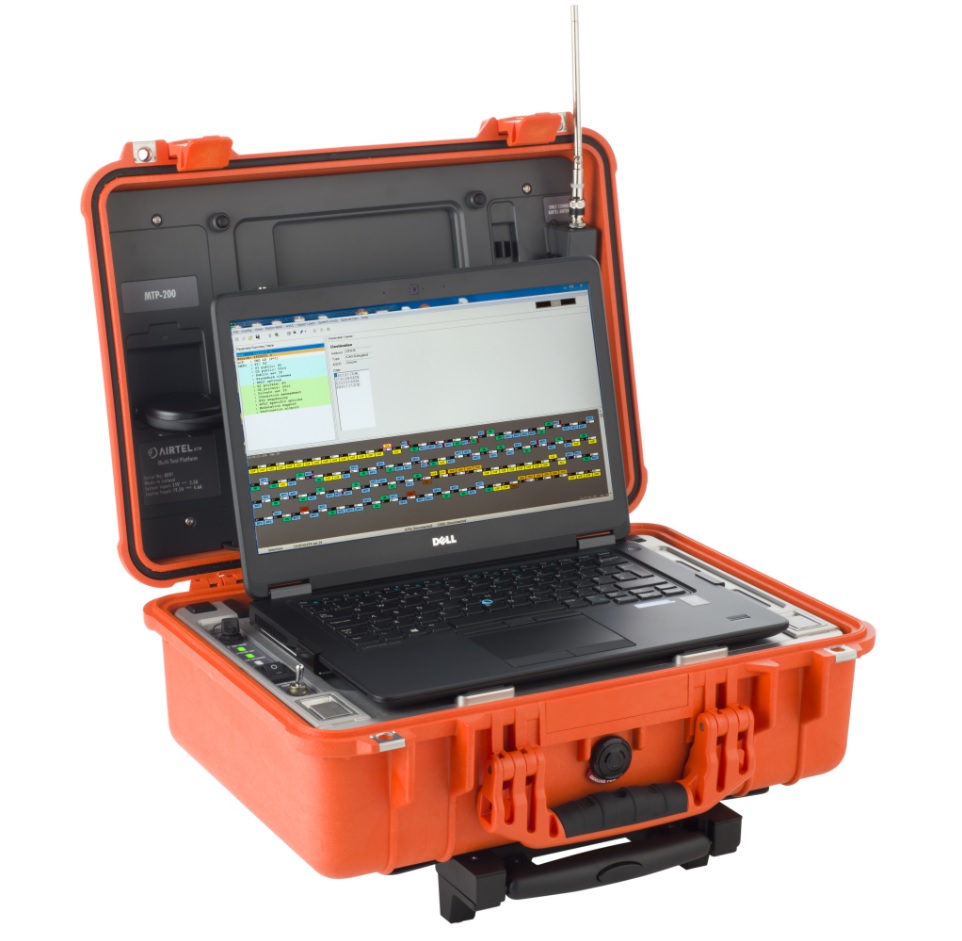
With 25 years of experience in the industry, Airtel’s innovative mobile MTP (Mobile Test Platform) brings comprehensive ATN/FANS CPDLC evaluations directly to the airport apron. It means testing can be carried out on the ground without requiring an aircraft to take off or connect to operational ground stations. Using the MTP not only saves valuable time but also helps minimize operational disruptions. Air operators use the generated reports as ‘Acceptable means of Compliance’ for EASA/FAA certification.